godaddy • product strategy • ai • future vision
Conversations Future Vision
Designing an AI business partner—not just another inbox assistant.
Role
Lead UX Designer
Year
2026
Context
GoDaddy has two products that are important to this story.
Conversations is a unified inbox for small businesses. It brings customer communications from channels like email, website chat, contact forms, Facebook, Instagram, and Google into one place so business owners can manage everything from a single inbox.
AiroHQ is GoDaddy's AI-powered workspace. It gives business owners access to specialized AI agents that help them complete tasks across their business, from validating a business idea to creating marketing plans.
As part of a company-wide AI initiative, we integrated Conversations into AiroHQ by launching an AI agent that could summarize customer messages, prioritize conversations, and help businesses train their chatbot.
It was a solid MVP—but it also felt like we had only scratched the surface.
Overview
I led a design-driven exploration into the future of GoDaddy Conversations. Although our roadmap had already moved on from AiroHQ after shipping an MVP, I believed there was a much larger opportunity. I initiated this exploration to answer a simple question: What if AI could help business owners run their business instead of simply helping them manage messages?
The opportunity
We had already launched a lightweight AI assistant that could summarize messages, prioritize conversations, and help train chatbots.
Useful—but incremental.
The more I looked at how small businesses worked, the more I realized: small business owners don't just have an inbox problem. They have a business operations problem disguised as an inbox.
- Answering the same questions
- Missing important customer requests
- Reacting to problems instead of growing their business
Instead of building another inbox feature, I wanted to explore what an AI business partner could look like.
Defining the vision
Rather than jumping into UI, I first wanted to understand where AI would actually provide value. I surveyed SMB owners to answer three questions: What inbox tasks do they actually want AI to help with? Where do they expect to stay in control? What would make them trust an AI assistant?
Three themes emerged
- 1AI should eliminate repetitive work.
- 2AI should organize information instead of simply displaying it.
- 3AI should assist—not replace—the business owner.
Those insights became the foundation for the experience.
Designing the experience
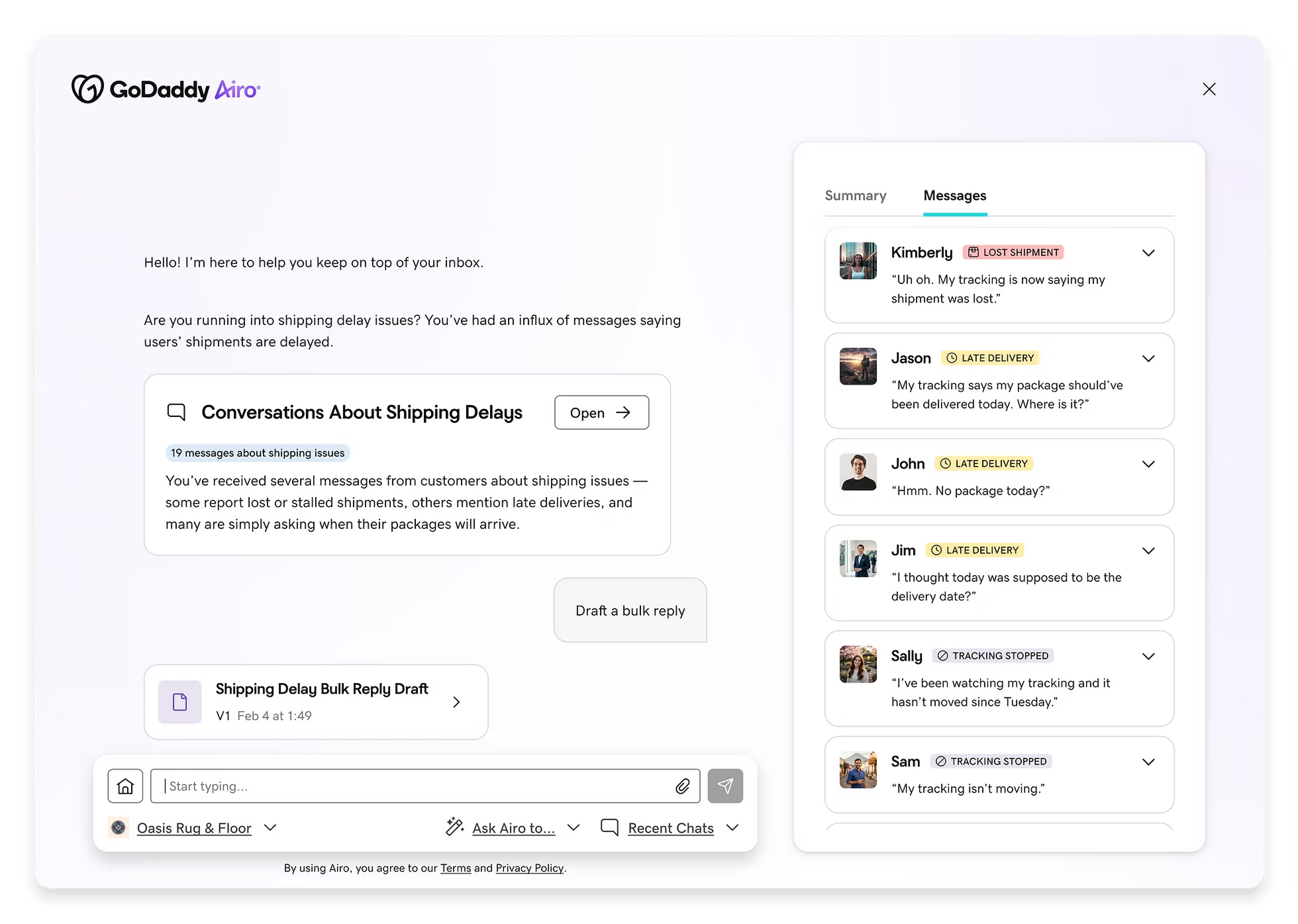
Working closely with the Conversations mobile designer, I explored multiple concepts before landing on a direction that balanced automation with user control.
The experience focused on allowing AI to
- Identify trends across conversations
- Group similar customer requests
- Draft responses in the owner's tone
- Surface urgent issues automatically
- Recommend bulk replies while keeping the owner in control of what gets sent
Validating the concept
Once the future vision was complete, I interviewed Conversations customers ranging from casual users to high-volume businesses.
I expected to validate AI features. Instead, the research uncovered something much more important.
The biggest insight
Businesses weren't struggling because AI was missing. They were struggling because they couldn't trust the inbox.
- Missing customer messages
- Unreliable notifications
- System messages buried alongside customer conversations
- Confusion about what Conversations actually did
One participant even lost a $5,500 job after missing a customer message.
That completely changed how I thought about the problem. Before AI could make businesses more efficient, Conversations first needed to become trustworthy.
Design principles
The research fundamentally shifted our priorities. Instead of "more AI," the future vision became guided by four principles:
Outcome
Although this project began as an exploration into AI-powered inbox management, it ultimately uncovered more fundamental usability issues that needed to be solved first. Rather than validating our original assumptions, the work reframed the opportunity:
What started as an exploration into AI-powered inbox management ultimately became a discovery project. Rather than validating new AI capabilities, it revealed foundational usability issues that had a far greater impact on customer success than any future AI feature.
Next steps
This information is hot off the press. The immediate next step is peeling Conversations back to its bones and addressing the fundamental issues highlighted by real users—before layering more AI on top.